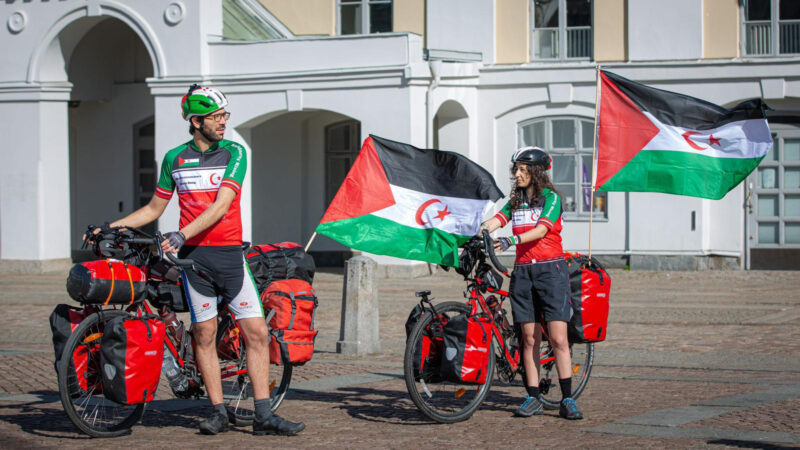
Benjamin Ladraa, left, and Sanna Ghotbi, right, co-founders of Solidarity Rising / Photo courtesy of Solidarity Rising
After the Great Wall of China, the second-longest wall in the world is in the Sahara. Around the 1,700-mile sand-and-stone wall runs a belt of more than 10 million landmines, believed to make up one of the densest minefields in the world. It cleaves Western Sahara in two.
To the west is the Atlantic coastline, the seaside oasis city of Laayoune, rich fisheries, and streams of white phosphate rock carried there from the mines by the largest conveyor belt in the world. Since 1975, this side has been under Moroccan occupation. A 15-acre Moroccan flag draped in 2010 across an empty square in Dakhla, a city in this occupied territory, makes that country’s claim clear.
To the east is desert — liberated territory controlled by the Sahrawi Arab Democratic Republic. It is from this side that militants of the Libya- and Algeria-backed Sahrawi independence movement Polisario waged an artillery-heavy guerilla war from 1975 until a ceasefire in 1991, when the Moroccan king promised the people of Sahara a referendum. Today, Sahrawis are still waiting to cast their vote, in refugee camps in the Algerian desert, in exile, and in occupied territory. It is on the eastern side of the wall that Sahrawis gather annually to demand that the wall come down, and that what lies behind it be returned to Sahrawis.
Morocco broke the ceasefire in 2020 — which is to say that a war for independence in Africa’s last colony is taking place at present, unbeknownst to much of the world. The political and public space of occupied Western Sahara is tightly controlled by Morocco, and while the United Nations mission set up decades ago to oversee the pending referendum is still there, thanks to France’s veto power in the UN Security Council, it is the only UN peacekeeping mission since 1978 that lacks a human rights mandate. This impotence, plus a total media ban since 1975, has effectively given Moroccan police, military, and settlers free reign over Sahrawi life in occupied Western Sahara.
Last year, human rights activists Benjamin Ladraa and Sanna Ghotbi quit their jobs and, capitalizing on the strength of their Swedish passports, embarked on a cycling tour longer than the circumference of the equator, through 35 countries in Europe, Asia, and Africa — for the sole purpose of raising awareness about Western Sahara.
Ladraa’s first trip to occupied Western Sahara was in 2019; he passed through 10 military checkpoints and found himself followed by secret police in the city. One day while his Sahrawi friend was driving him, they were followed by almost a dozen vehicles. Their escape was like a Hollywood car chase; they called more Sahrawis to join in the drive, cutting off the Moroccan security personnel, and Ladraa switched into different cars. At a safehouse, Ladraa filmed interviews with Sahrawis, many of whom were former political prisoners. Ladraa asked them if they would risk arrest for speaking on such a topic. “Of course,” Ladraa remembers them saying. “Our life here is a prison.”
Ghotbi visited Sahrawi refugee camps in Algeria for the first time in January 2022, after the camps reopened to international visitors. (The pandemic had crippled the camp’s already-frail healthcare facilities.) Ghotbi, who is Kurdish and whose parents have not returned to the Kurdish region of Iran for 40 years, related to those Sahrawis under the age of 50 who had never seen their home country, whose heritage existed in the memories of their parents and grandparents.
Ladraa and Ghotbi’s particular configuration of solidarity — connecting, both in conversation and in trajectory the parallel struggles of occupied territories globally — piqued my interest. I reached out to them when they were in Fukushima, on a slower stretch of the trip while Ghotbi recovers from an injury. At the time of our call, Ladraa had been whisked away to speak to a Japanese journalist and later shared that he’d been invited by his host to visit a family that cultivates the bonsai trees of Kyoto’s imperial garden; the bonsai experts shared their trees, and Ladraa shared the story of Western Sahara. In the meantime, Ghotbi spoke to me about their 25,000-mile Bike4WesternSahara tour.
— April Zhu for Guernica
Guernica: Though Western Sahara may appear to be in perpetual stasis, locked in stalemate, there have been significant political developments in the last three years. Could you speak about them?
Ghotbi: There has been a ceasefire for about 30 years between Morocco and the Polisario, but in 2020, Morocco began building a road in one of the demilitarized zones. A group of Sahrawis protested this road, making a protest camp in tents where it was going to be built. Morocco responded with their military. They were pretty violent and arrested a lot of the Sahrawis who were protesting — and that restarted the war. In the past few years, dozens of civilians have died. Even Algerian and Mauritanian civilians have been killed by drones, bought from China and Israel, that Morocco flies along the wall. The nomadic Sahrawis who used to live on the unoccupied side of the wall have had to move into the refugee camps.
The second thing that happened is the 2020 Abraham Accords, the deal that the Trump Administration made in an attempt to normalize relations between Israel and many Arab nations, including Morocco. Basically they made the Moroccan government agree to recognize Israel’s occupation of Palestine in exchange for the US and Israel recognizing Morocco’s occupation of Western Sahara. No one had done that before. About 80 countries recognize Western Sahara’s territorial integrity as a country, but the US became the first country to erase Western Sahara from its official map, to start teaching children that this is Moroccan Sahara. Israel recently became the second country to do that.
Guernica: Why isn’t there more international awareness of Western Sahara?
Ghotbi: One of the reasons people don’t know about Western Sahara is there are no international press offices there, and no major international presence except the UN mission, which is pretty useless. The occupied territory has never been open to journalists. Journalists can only go there if they manage to sneak in and not show their press credentials.
 Observador Saharaui